Essex Society for Family History

Logo

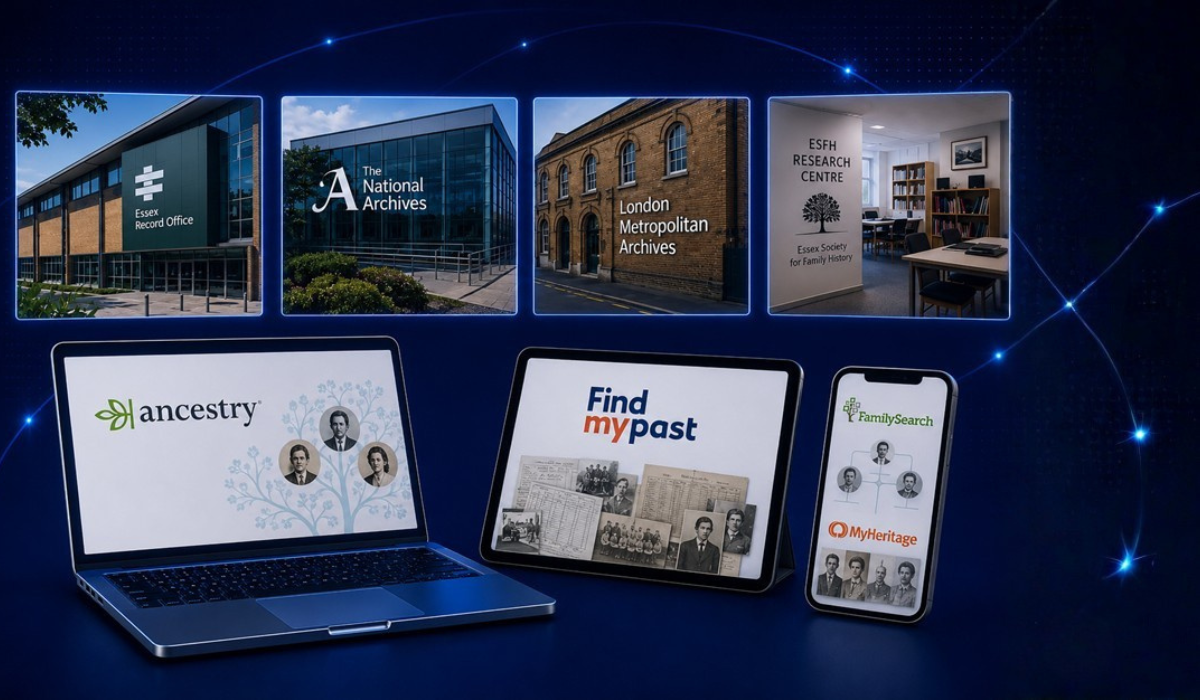
Researching your family history has never been more accessible. With new records added online every day, there are more opportunities than ever to uncover your past—whether you're just beginning or have been researching for years.

No single website or archive holds a complete collection of records. Coverage differs between sources and some materials may overlap. It is important to confirm that any resource you plan to use includes records relevant to the places and time periods you are researching.

Before subscribing to a paid service, check with your local library. Many libraries provide free access to major genealogy websites such as Ancestry and Findmypast, and may also offer access to local parish registers, census records, and other valuable resources.

The £ sign indicates online sites that require a subscription to access their records. These sites offer some free records and may provide free access to select collections during historical anniversaries or commemorative events.

The Essex Society for Family History (ESFH) is a well-established organisation dedicated to helping people research their family history, with a focus on Essex. Founded in 1974, the Society has built a rich collection of genealogical resources. Many of these records are unique to the Society and not available elsewhere. ESFH is an invaluable resource for anyone tracing family history in Essex.

Records

Their collections include parish register transcripts and indexes for baptisms, marriages, and burials, census indexes, monumental inscriptions from local churchyards and other places, wills and probate abstracts, as well as historical directories. Due to historical boundary changes they also hold some records from adjoining jurisdictions, notably the East of London Boroughs.

ESFH also offers access to photographs and local history materials that add rich context to your research. Members receive a quarterly journal featuring articles, transcriptions, and updates on new records and research tips.

Online Access

The majority of ESFH’s records are available online, free to members, in the TRACE Databases on this website.  Non-members can conduct searches and view the number of matching results, but access to the full records is restricted to members.

Visiting

The ESFH Research Centre is located within the Searchroom, on the first floor of the Essex Record Office, Wharf Road, Chelmsford, CM2 6YT. The Searchroom is open Tuesday to Thursday (10am-5pm) every week. Every four weeks, opening hours extend to Friday and Saturday (9am-4pm), and it stays open until 8pm on a Tuesday. Check the ERO Searchroom calendar before your visit.

The ESFH Research Centre is open to both members and the public on Tuesdays from 1 pm to 4 pm and Thursdays from 10 am to 1 pm. The Research Centre provides computers with access to the ESFH online collection, along with the complete set of GRO birth, marriage, and death indexes, including overseas registrations, both civil  and military, on microfiche (1837–2001), transcribed records, and a comprehensive research library. Experienced volunteers are on hand to offer expert advice and support.

Access is inside the Public Searchroom and requires an Archives Card. Register online through the Archives Card Hub and collect your card at ERO reception within three months.  We highly recommend that you read ERO information about using the Searchroom.     

Members are entitled to discounted printing and other services upon presenting their membership number.

Become an ESFH Member

Joining the Essex Family History Society grants access to exclusive resources, publications, and events. Membership also includes access to the Society’s extensive record databases. Membership details and sign-up options are available on the ESFH website.
The Essex Record Office (ERO) in Chelmsford is the county’s primary archive for historical and genealogical records. It provides researchers with comprehensive access to a wide array of original documents vital for exploring Essex’s past.The facility features well-equipped reading rooms and on-site digital resources, enabling research of both physical and electronic archives. Experienced staff are on hand to assist with enquiries, guide users through complex records, and offer expert advice on accessing and interpreting archival materials.

Records

The ERO holds an extensive range of records including parish registers of baptisms, marriages, and burials dating back centuries, wills and probate records, census returns, historic maps, and monumental inscriptions. The archive also houses local government records, electoral registers, and burial indexes, providing a comprehensive resource for tracing Essex ancestors across multiple generations.

Online Access

Essex Archives Online provides digital access to thousands of documents, including historic parish registers and wills. While a limited selection of images, mainly pictorial, are free to view, most require registration and a subscription for remote access.

The Essex Archives Online is a full catalogue of the ERO’s holdings, not all of which are digitised. Before subscribing verify that your desired documents have been digitised. Subscription options range from one day to one year.

Visiting

The ERO is located on Wharf Road in Chelmsford offers public access to a vast range of historical records through its Searchroom. The Searchroom is open Tuesday to Thursday (10am-5pm) every week. Every four weeks, opening hours extend to Friday and Saturday (9am-4pm), and it stays open until 8pm on a Tuesday. Check the ERO Searchroom calendar before your visit. 

Before visiting, it is important to understand how the Essex Record Office operates. Access is straightforward, but a small amount of preparation will ensure your visit runs smoothly.To gain access, you will need to apply for an Archives Card online and collect it in person with valid ID. 

For more information about visiting details and access to digital collections, go to: www.essexarchivesonline.co.uk

The London Archives (formerly London Metropolitan Archives) is one of the UK’s largest repositories for London’s history from medieval times to today. Located in Clerkenwell, it offers free public access to extensive records, serving as a key resource for genealogists, historians, and researchers interested in the city’s social, economic, and cultural development.

Collections

The archives hold a vast array of documents including parish registers (baptisms, marriages, and burials), wills, workhouse and poor law records, school and hospital registers, as well as an extensive collection of maps, photographs, drawings, and films. The catalogue contains over three million entries, many of which are searchable online, with a selection of digitised materials accessible remotely.

Online Access

The London Archives’ online collection includes digitised parish registers (baptisms, marriages, burials), wills, electoral registers, historic maps, photographs, workhouse records, school and hospital registers, business directories, and land tax records.

Note: You will need an Ancestry subscription to access some of these records.

Visiting

The London Archives is located at 40 Northampton Road, London EC1R 0HB. Access to original records requires registration for a History Card, which is free of charge and requires valid identification. Researchers are encouraged to consult the online catalogue in advance and to pre-order documents for their visit.

For more information about visiting details and access to digital collections, go to thelondonarchives.org.

The National Archives, located in Kew, London, is the official archive of the UK government and one of the largest archives in the world. It preserves millions of documents dating back over a thousand years, covering a vast range of subjects including government records, census data, wills, military service files, court records, treaties, and more. Whether you’re tracing your family history, conducting academic research, or investigating legal precedents, The National Archives offers unparalleled access to primary source documents that are essential for in-depth study of Britain’s past.

Visiting

The National Archives is open to the public Monday through Friday, offering onsite reading rooms where visitors can freely access original documents. To use these facilities, you must register for a reader’s ticket, which requires proof of identity. The building also hosts exhibitions, talks, and educational events to engage the public with its collections.

Online Access

A significant portion of the collections has been digitised and is accessible through the National Archives’ comprehensive online catalogue, allowing researchers worldwide to search and view many records remotely. While much of the content is free to access, some records may require payment. The website also offers extensive research guides, advice on using the archives, and digital learning resources.

For more information about visiting and access to digital collections, go to nationalarchives.gov.uk.

The Society of Genealogists (SoG) is a leading UK charity dedicated to helping people discover and research their family history. Founded in 1911, the SoG has become one of the UK’s most respected genealogical organisations. Whether you’re just starting out or have years of experience, the SoG offers expert guidance, a wealth of resources, and a supportive community to help you explore your ancestry.

Collections and Resources

The SoG boasts one of the largest genealogical libraries in the UK, featuring a wide range of resources essential for family history research. These include parish registers, census records, probate and will indexes, newspapers, directories, family histories, and more. The library holds original documents, microfiche, printed materials, and digital records—providing you with comprehensive tools to trace your lineage.

While the SoG primarily focuses on British and Irish genealogical records, its collections also cover regions with strong historical ties to Britain, making it a valuable resource for a broad range of research interests.

Services

Beyond its collections, the Society offers a wide variety of educational opportunities such as courses, workshops, lectures, and seminars designed to improve genealogical research skills. These programs cover topics like how to use archives, decipher old handwriting, DNA testing, and advanced research techniques. Expert staff and experienced volunteers are available to provide guidance and support to members and visitors alike.

Membership and Access

The Society of Genealogists is based in London, where it operates a well-equipped library open to both members and visitors. While membership provides full access to resources and online databases, non-members can also visit the library, usually for a small fee. Many services, including educational materials and certain digital resources, are accessible online, allowing members to benefit from the Society’s offerings remotely.

For more information about visiting and access to digital collections, go to sog.org.uk

Findmypast

Findmypast (FMP) is a subscription website with a strong collection of Essex records. It specialises in British and Irish family history, but also has records from the US, Canada, Australia and New Zealand.

Essex records on Findmypast

ESFH works in partnership with Findmypast and has supplied some of its TRACE datasets. These include the Essex Monumental Inscriptions, which hold over 200,000 transcripts from two decades of work by ESFH volunteers. FMP's other Essex records include:

  • Essex Baptisms, 1538–1917 (over 2 million records)
  • the Essex Burial Index, 1530–1994 (over 1.5 million records)
  • Essex marriages and banns
  • civil registration indexes
  • Essex Regiment service records
  • electoral registers
  • probate indexes
  • school admission registers and log books

Essex newspapers

FMP shares its newspaper archive with the British Newspaper Archive. Its Essex titles include the Essex Newsman, Essex Times, Essex Herald, Essex Standard, Essex Weekly News, Chelmsford Chronicle, Brentwood Gazette, Saffron Walden Weekly News and Southend Standard and Essex Weekly Advertiser. Use them to find birth, marriage and death announcements, inquests, court reports and local news.

Resources and features

Beyond Essex, FMP holds civil birth, marriage and death indexes from 1837, the England and Wales censuses from 1841 to 1921 and the 1939 Register. It also has one of the largest online collections of parish registers, records from both World Wars, travel and migration records, court records and millions of pages of British and Irish newspapers. Its free family tree builder gives automatic hints that suggest matching records and other users' public trees.

Access and cost

FMP offers several subscription levels, depending on whether you want UK-only or worldwide records. Many public libraries and archives give free access to FMP on site, which covers most of the core records.


Ancestry is one of the world’s largest and most well-known genealogy websites, offering access to billions of historical records from around the globe. Based in the United States, it provides a rich suite of tools to help users explore their heritage, build detailed family trees, and uncover ancestral connections. With its extensive international coverage, intuitive search features, integrated DNA services, and a vast collection of user-submitted trees, Ancestry is a comprehensive and accessible resource for both newcomers and seasoned family historians.

Collections and Resources

Ancestry offers access to a vast collection of historical records, including birth, marriage, and death indexes; full UK and US census returns; parish registers; military service and pension files; immigration and travel documents; newspapers, directories, school records, and user-submitted family trees that can reveal shared ancestors.

The built-in family tree builder with automated hints and record suggestions help to uncover new connections. Its intuitive interface integrates historical documents seamlessly, and advanced filters make it easy to refine searches.

AncestryDNA is Ancestry’s genetic testing service that offers detailed ethnicity estimates from over 1,800 regions worldwide, with particular strength in UK and European ancestry. It also identifies genetic relatives, allowing users to explore family connections and expand their family tree. When linked to a public tree, features like ThruLines™ help trace relationships between DNA matches and shared ancestors. The test is autosomal, covering both maternal and paternal lines. It does not include health reports. Ancestry does not support DNA uploads from other services.

Access and Subscription

Ancestry is a subscription service, with various subscription options depending on the record collections you want to access (UK, international or all record sets).
Some public libraries and archives provide free in-library access to Ancestry Library Edition, which includes many of the core records (but not DNA or personal trees).

For more information go to: www.ancestry.co.uk

Key Features and Records

The Genealogist provides a wide range of UK-focused records, including birth, marriage, and death indexes for England and Wales, along with census data from 1841 to 1911 and transcripts of the 1921 census. It features parish registers, nonconformist records, wills, probate files, and land ownership documents, as well as tithe records and detailed maps that show how land was used and who occupied it. Military service records from both World Wars are available, along with occupational and educational documents such as directories and apprenticeship records. The platform also offers advanced tools like Map Explorer and Surname Distribution, which allow users to trace ancestors by location and explore how surnames were spread over time.

Access and Subscriptions

The Genealogist is a subscription service with subscription options, for family historians, professionals and those researching specific record types.

Some public libraries and archives may provide free onsite access.

For more information go to: www.thegenealogist.co.uk

MyHeritage is an international genealogy website based in Israel, offering tools to explore family history and connect with relatives worldwide. It provides access to billions of historical records, a powerful family tree builder, and DNA testing for ancestry and health insights. Known for its global reach and multilingual support. MyHeritage is especially helpful for those with European roots or international family connections. Its combination of global records, DNA matching, and user-friendly tools make it a valuable platform for discovering and preserving your family history.

Records and Features

MyHeritage offers a large range of historical records, including birth, marriage, and death certificates, census data, military files, immigration records, newspapers, and more. Its record collections are particularly strong for European countries, featuring many regional resources that are difficult to find elsewhere.

The platform uses advanced matching technology to compare your family tree with historical documents and other users’ trees, automatically suggesting relevant connections. Its Smart Matching™ feature further helps identify shared ancestors and links between family trees.

MyHeritage also provides a widely used DNA testing service that delivers detailed ethnicity estimates from over 2,000 regions and connects users with genetic relatives. Users can upload raw DNA data from other providers, such as Ancestry.

The site includes photo enhancement and colourisation tools, and features like deep AI-based photo animation. It’s available in over 40 languages, making it especially useful for users with multilingual family histories.

Access and Subscription

While building a family tree is free, full access to records and advanced features requires a subscription. DNA tests are purchased separately, though often available at discounted rates. MyHeritage also offers a free basic plan with limited features and storage.

For more information go to: www.myheritage.com

FamilySearch is a free, non-profit genealogy platform operated by The Church of Jesus Christ of Latter-day Saints (LDS). As one of the largest and most popular family history resources worldwide, it provides access to billions of historical records, collaborative family trees, and a variety of research tools which are all free. It serves both beginners and experienced researchers, particularly those interested in building shared family trees, exploring free global records, or obtaining personalised research assistance.

Records and Features

FamilySearch offers an extensive collection transcriptions and digitised records from across the globe, including birth, marriage, death, burial records, census data, probate files, immigration documents and more. Its holdings are particularly strong for the United States, Europe, and Latin America, with expanding coverage worldwide.

FamilySearch also has a dedicated page which lists all major websites that hold Essex on-line records. Some subscription websites listed can be searched for free at ESFH Research Centre as we are a FamilySearch affiliate library. Additionally, features such as the interactive England Jurisdictions 1851 Map is an excellent tool for identifying Parish, Civil, Poor Law Union, etc boundaries by using the selectable map layers for different jurisdictions in 1851.

A feature is the Family Tree which is a shared, collaborative tree that invites users to contribute and refine common ancestral lines. Unlike private trees on other platforms, FamilySearch’s tree is openly accessible and designed for collective building, fostering a community approach to genealogy.

Complementing this is the FamilySearch Wiki, a rich, free online resource crafted to support genealogists of all levels. More than a traditional wiki, it serves as an encyclopaedia of genealogical knowledge, offering online Guided Research advice, Research Strategies, an Essex Record Finder,, history, and methodologies. Continuously updated by experts and volunteers, it provides reliable, practical information ranging from accessing census and church records to understanding naming conventions, migration patterns and DNA testing. The Wiki also includes directories to archives, libraries, and online databases worldwide, making it an indispensable tool for deepening genealogical research.

Access and use

FamilySearch is completely free to use, however you must sign up for an FamilySearch account to access most features. Some records are restricted to viewing at FamilySearch Affiliate Libraries or LDS Centres due to licencing agreements. For more information go to: www.familysearch.org

Free UK Genealogy is a UK-based charity dedicated to making family history research freely accessible to all. Its mission is to remove financial barriers by providing open access to historical records online, helping people from all backgrounds explore their ancestry with ease.  The project is powered by volunteers and funded through donations, grants, and partnerships with libraries and archives.

Records

The organisation oversees three major projects offer a wide range of vital records covering England, Wales, and parts of Scotland, with a focus on digitising hard-to-access documents that often require paid subscriptions elsewhere.

  • FreeBMD – Transcriptions of civil birth, marriage, and death indexes for England and Wales

  • FreeCEN – Access to historic UK census returns

  • FreeREG – Parish register transcriptions of baptisms, marriages, and burials

Click the links above to access each site.

The Online Parish Clerks (OPC) Project began in the 1990s as a grass roots effort to make parish records more accessible to the public. Traditionally, these handwritten registers were stored locally and were often difficult to access, especially for researchers unable to visit in person. OPC volunteers, many of whom possess detailed knowledge of their local areas, transcribe and publish these records online, making them searchable and easier to use.  The records provided by OPC often complement those held by larger national archives or commercial genealogy websites, filling important gaps, especially for vital events before civil registration began in 1837.

Key features

The Online Parish Clerks (OPC) Project provides wide-ranging coverage, with a primary focus on parish registers, while also encompassing related sources such as census substitutes, monumental inscriptions, wills, and other local records. The extent of this material varies by parish and county, but together it spans numerous rural and urban areas across England, Wales, and, in some cases, other parts of the UK. OPC websites typically feature searchable databases or downloadable indexes that contain key life events and, where available, additional details such as parents’ names, occupations, and other contextual information that enrich the genealogical record.

Access

Researchers seeking OPC records can locate them by searching for the relevant parish or county in conjunction with “Online Parish Clerk.” Most OPC sites provide free access to these valuable transcriptions, making them a preferred resource for family historians wishing to avoid subscription fees, though some may invite donations to support their ongoing efforts. Organized regionally by county, many OPC groups maintain independent websites or contribute to shared portals, forming a cohesive network that encompasses multiple parishes within each area.

Our Opening Hours

For Research Centre Opening Hours
Please ask today's volunteer

Respect & Protect

Respect copyright and data protection.
Do not save personal data to these PCs.

Feedback

We welcome your feedback to help us
improve the Research Centre

Computer

Research Centre PC
ESFH-01

Computer

Research Centre PC
ESFH-02

Computer

Research Centre PC
ESFH-03

© Copyright. Essex Society for Family History. All Rights Reserved.  Registered Charity No 290552
Website by Beachshore

Website by Beachshore