
Essex Society for Family History

Logo

Essex Surnames

Essex Surnames has embarked on a dedicated programme to identify, document, and verify surnames with historical origins in Essex, England. The project aims to compile a comprehensive and authoritative index of surnames originating in the county, with each name carefully analysed using genealogical, geographical, linguistic, and statistical evidence to ensure accuracy and depth.

The overarching goal is to create a long-term, open research platform and searchable index that will serve not only members of the Essex Society for Family History but also genealogists, historians, and surname researchers around the world. By combining rigorous methodology with accessibility, the initiative aspires to become a central reference for understanding the heritage and evolution of Essex surnames.

The sections below provide a detailed explanation of the processes by which surnames are selected, assessed, and researched. They outline the criteria for inclusion, the methods used to gather and evaluate evidence, and the systematic approach applied to each surname to ensure accuracy, reliability, and scholarly rigour throughout the investigation.

The Essex Surnames initiative is designed to deliver tangible benefits to the family history community by making surname research in Essex more accessible, reliable, and collaborative. Its outcomes are intended to support researchers at every level, from individual genealogists to advanced surname scholars.

For Members of the Essex Society for Family History (ESFH):

The initiative will provide detailed surname information and supporting evidence that directly enhances the Society’s Registered Surname Interests programme. By strengthening the resources available to members, it adds practical value to ESFH membership, while also fostering opportunities for direct contribution, shared expertise, and collaboration in surname research.

For Genealogists and Family Historians:

The project will assist in determining whether a surname originated within Essex before spreading beyond the county, across England, and eventually around the globe. This evidence can play a crucial role in helping researchers overcome long-standing genealogical “brick walls” and place family histories within a broader geographical and cultural context.

For One-Name Study Researchers:

By identifying surnames with demonstrable Essex roots, the project offers valuable guidance to those conducting one-name studies. It highlights surnames worth investigating within an Essex framework, enabling researchers to refine their focus and strengthen the contextual basis of their work.

For DNA and Surname Match Analysts:

The evidence generated by the initiative will provide stronger foundations for surname hypotheses, especially for those exploring Y-DNA surname connections. By aligning genetic evidence with historical surname data, researchers will be better positioned to confirm or challenge connections across family lines and surname clusters.

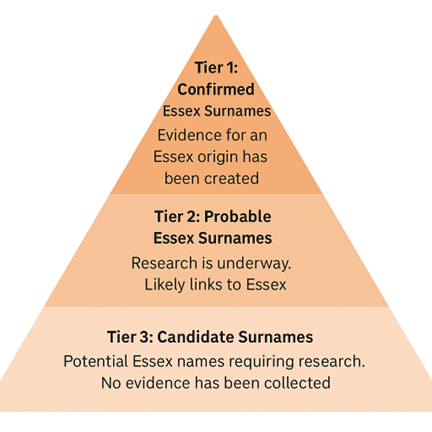
The project is built upon a tiered model of surname confidence levels, designed to provide clarity, transparency, and academic rigour in the classification of Essex surnames. This structure ensures that every name included within the framework has been subjected to a consistent process of evaluation, while also allowing for flexibility as new evidence emerges.

The assessment of surnames relies on robust methods of validation, drawing on multiple strands of evidence. Statistical data is used to measure surname frequency and persistence across different periods; geographical analysis helps identify distribution patterns and localised concentrations within Essex; academic sources contribute linguistic, historical, and cultural insights; while genealogical records provide the documentary backbone that ties families and communities to specific places and times. Together, these methods create a multidisciplinary foundation for surname research that is both reliable and adaptable.

Within this framework, surnames are classified into three distinct tiers:

  • Tier 1: Confirmed Essex Surnames

    These represent surnames that have been fully evidenced, verified, and documented as originating in Essex. Inclusion at this level indicates the highest degree of confidence, based on a convergence of historical, linguistic, genealogical, and statistical proof.

  • Tier 2: Probable Essex Surnames

    Surnames in this category are those for which research is still ongoing, but where the available evidence strongly suggests an Essex origin. While not yet fully confirmed, these surnames show a clear weight of probability that supports their Essex connection, pending further validation.

  • Tier 3: Candidate Surnames

    This category comprises potential Essex surnames, often identified initially through the Members’ Surname Interest registry. These surnames require a preliminary review to establish whether they show sufficient promise for deeper research. Where initial findings are positive, they may be advanced to Tier 2 for more detailed investigation and evaluation.

By adopting this tiered model, the project ensures that every surname is approached with scholarly care and methodological consistency. It also provides a transparent pathway for the progression of surnames from candidate to probable and, ultimately, to confirmed, reflecting both the rigour of the research process and the evolving nature of historical surname studies.

The inclusion of surnames within the Essex Surnames initiative is guided by a clear principle of relevance to the membership of the Essex Society for Family History (ESFH), while also being grounded in rigorous historical and statistical evidence. The process begins with the Society’s Members’ Surname Interest register, which reflects the active research priorities of our members, and is combined with quantitative analysis of surname frequency and concentration within Essex. This dual approach ensures that surname selection is both community-driven and evidence-based.

The selection methodology is structured into three key stages:

Step 1: 1881 Census Surname Frequency Analysis

The process commenced with the historic 1881 Census for Essex, from which the top 500 surnames were extracted. Each surname was then assessed using the Banwell Index, a recognised statistical measure of surname concentration. The Banwell Index compares the relative distribution of a surname within Essex against its occurrence across the wider population of England and Wales. Only surnames achieving a score of 25 or higher, indicating a strong geographical association with Essex, were shortlisted for the next stage.

Step 2: Comparison with the Members’ Surname Interest Register

The statistically significant surnames identified in Step 1 were then cross-referenced against the Members’ Surname Interest Register, which records the surnames that ESFH members are actively researching. This stage ensures that the surnames selected for further investigation are not only historically rooted in Essex but also directly aligned with the interests of our membership, thereby increasing the practical value of the project.

Step 3: Selection for Research (Tier 2)

From the intersection of statistical significance and member interest, an initial cohort of ten surnames was identified. These surnames were advanced to Tier 2: Probable Essex Surnames, making them the subject of detailed evidence collection, validation, and analysis. Over time, as additional evidence accumulates, these surnames may progress to Tier 1: Confirmed Essex Surnames or, where appropriate, be reclassified.

Through this structured methodology, the Essex Surnames initiative ensures that surname inclusion is transparent, systematic, and responsive both to the needs of its members and to the standards of historical and genealogical research.

The following outlines the research approach for surnames under Tier 2: Probable Essex Surnames, detailing how available historical, genealogical, linguistic, and geographical evidence is gathered and documented. This method ensures that every surname is investigated with both rigour and transparency, forming a solid foundation for future confirmation and study.

1 - Multi-phonetic systems (Soundex, Metaphone, Double Metaphone and NYSII) analysis is used to comprehensively identify variants.

2 - Statistical Analysis using census information for Essex & UK surname frequency data. The Banwell Index is used to create a standard measure of surname concentration and deviation from expected distribution.

3 - Geographical & Migration Analysis is undertaken to identify and explain surname concentrations within Essex and (variant) migration to adjacent counties.

4 - Academically researched surname dictionaries (e.g., Oxford Dictionary of Family Names in Britain and Ireland and Oxford Dictionary of English Surnames) are used to verify surnames being researched at Tier 2. Additionally etymological explanations are reviewed for linguistical origin (e.g. Old English, Norman French, Latin), surname meaning and type e.g. place name, job title, nickname or patronymic.

5 - Genealogical Records & Pedigrees are researched to identify:

• Early documented instances in Essex (pre-1600 where possible).

• Established lineages and family trees with Essex roots across multiple generations.

• Supporting evidence from wills, deeds, settlement certificates, and poor law records.

The first ten surnames selected for the Essex Surnames initiative are listed below. Each name is being explored in depth, drawing on genealogical records, geographical patterns, statistical measures, and linguistic evidence to trace its roots and connections with Essex.

As research on each surname reaches a sufficient stage of completion, a dedicated page will be created on this website. These pages will present the findings in a clear and accessible way and will be linked from this section, allowing readers to follow the progress of the project as it unfolds.

Over time, this process will form a growing library of Essex surnames, offering insight, context, and evidence for family historians, surname researchers, and all who share an interest in the county’s heritage.

1. Ridgewell/Redgewell/Ridgwell/Redgwell

2. Dowsett/Dowset

3. Angier

4. Ardley

5. Bures/ Bewers

6. Campen

7. Chatters

8. Cottis/Cottiss/Cottee

9. Layzell/Lazell/Lazzell

10. Lindsell/Linsell

We invite ESFH members, surname researchers, and local historians to become active contributors to the Essex Surnames project.

Here’s how you can contribute to the project:

Submit a Surname Interest — Propose a surname (and variants) you believe has Essex origins. Provide any initial observations or clues about its possible Essex connection.

Contribute Research — Help gather additional records for a surname already listed in Tier 3 or Tier 2.

Provide Citations — Ensure all findings are supported by properly cited sources (archival reference, book, database). Avoid anecdotal or family lore unless it can be corroborated.

Assist with Data Mapping — Help chart the distribution and migration of surnames using Excel or mapping tools. Assist in generating visual aids such as migration maps or surname prevalence charts.

Join the Discussion — Use the ESFH website’s upcoming chat tool to connect with other researchers. Participate in surname research discussion threads or forums.

All Tier 1 surnames, having been thoroughly researched and verified as originating in Essex, will be recorded in the Essex Surnames Index.

This index will serve as a comprehensive reference, providing researchers, genealogists, and local historians with a detailed and accessible record of each surname.

For every Tier 1 entry, the index will include:

– Date and locality of earliest record
– Etymological meaning
– Known variants
– Migration patterns (if any)
– All source references and statistics
– A confidence statement justifying its Tier 1 classification

Use the form below to search through our data.

Click 'Search' to browse.


Our Opening Hours

For Research Centre Opening Hours
Please ask today's volunteer

Respect & Protect

Respect copyright and data protection.
Do not save personal data to these PCs.

Feedback

We welcome your feedback to help us
improve the Research Centre

Computer

Research Centre PC
ESFH-01

Computer

Research Centre PC
ESFH-02

Computer

Research Centre PC
ESFH-03

© Copyright. Essex Society for Family History. All Rights Reserved.  Registered Charity No 290552
Website by Beachshore

Website by Beachshore