Essex Society for Family History

Logo

Black Friday and Christmas DNA bargains – time to look out for offers!

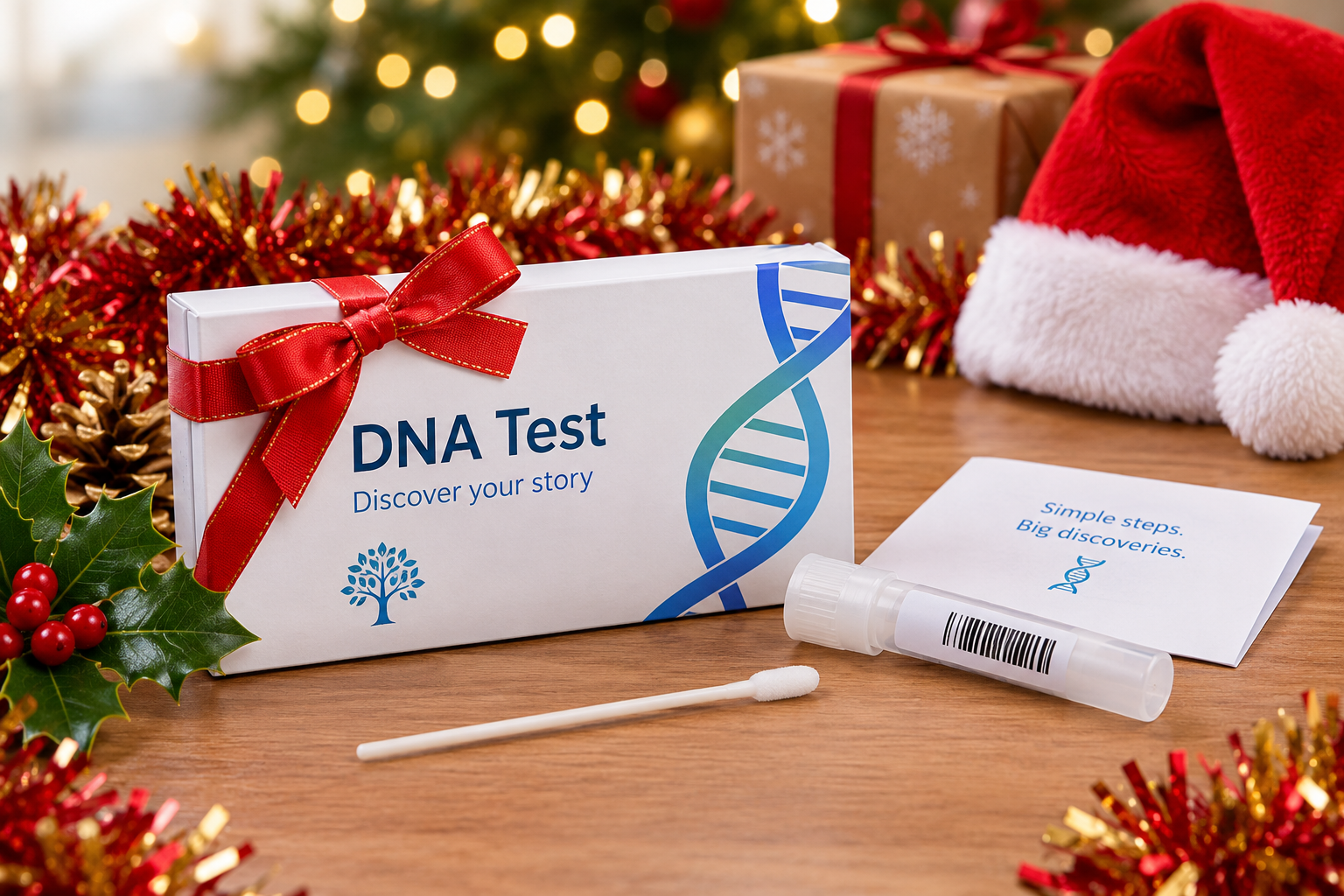
Thinking of taking a DNA test, encouraging a relative to test, or perhaps giving someone a DNA kit for Christmas? This could be a good time to buy!

With Black Friday approaching on 27 November, several major DNA testing companies have already announced substantial discounts, and there may be further offers in the run-up to Christmas.

For family historians, DNA testing can provide valuable clues about our ancestors, help us discover previously unknown relatives and sometimes break through those stubborn brick walls.

And if you've already tested, don't forget that testing an older relative, a cousin or someone from a different branch of your family can sometimes be even more useful than taking another test yourself.

Where to find the latest offers

The following companies are worth checking for Black Friday and Christmas promotions:

   •  AncestryDNA – Currently offering substantial discounts on its autosomal DNA test, which can help identify genetic relatives and provide clues about your family origins.

   •  MyHeritage DNA – Has launched an early Black Friday promotion, with discounted DNA kits. Its international DNA database may be particularly useful for finding relatives overseas.

   •  FamilyTreeDNA – Offering discounts across its range of tests, including Family Finder (autosomal DNA), Y-DNA and mitochondrial DNA tests, as well as upgrades for existing customers. See its Black Friday offers and prices.

   •  Living DNA – Another testing company worth checking for seasonal offers, particularly for those interested in more detailed regional ancestry information.

A few things to remember before buying

   •  Check the final price, including delivery charges and any additional fees.

   •  Look carefully at subscription offers and automatic renewal conditions.

   •  Consider which company's database and testing options will be most useful for your family history research.

   •  If buying a test as a gift, make sure the recipient is happy to take a DNA test and understands that the results may reveal unexpected family connections.

Please note: ESFH has members throughout the world, and prices, currencies, availability and promotional offers may vary depending on your country. Offers can also change or end at short notice, so always check the testing company's website for the latest details.

Who knows? Your next family history discovery might be waiting in someone's Christmas stocking!


An Inside Look at the 2026 AncestryDNA Origins Update


Following our recent news item about AncestryDNA’s 2026 Origins update, Ancestry has produced a video featuring some of the people behind the changes. Nicka Sewell-Smith, Manasa Boriah and Aaron Wolf discuss the science behind the update and what it means for your results.

Ancestry Insiders insights into the Origins update


With the number of regions increasing from 146 to 302, the update may bring changes to your percentages and regional breakdown. If you’re wondering why your results look different, watch Ancestry’s inside look at the Origins update to find out more.

AncestryDNA doubles its ethnicity regions

On 8 October Ancestry released its biggest ethnicity update yet. The number of regions it can link your DNA to has more than doubled, from 146 to 302. The update is free, and existing results are reprocessed automatically, so there’s no need to test again. Most of the new regions are in the Americas, Africa and South Asia. In Europe, new regions have been added in the Balkans and Central Europe.

There are no new British or Irish regions this time. However, Ancestry says it now separates French ancestry from neighbouring areas more clearly, and it names South-East England as one of them. That’s worth noting for Essex researchers, given the county’s long cross-Channel links. Behind this is a reference panel that has grown by nearly 60%, to over 295,000 people, plus a new AI-assisted method of analysis.

Expect your percentages to shift, and some small regions may disappear. Your DNA hasn’t changed; only Ancestry’s interpretation of it has. Treat ethnicity estimates as a broad guide. Your DNA matches, backed by documentary research, remain the best way to use DNA to extend your Essex tree.

BanyanDNA has announced the release of Version 1.10, introducing several useful new features for genetic genealogists.

The headline enhancement is the ability to import DNA match data into your BanyanDNA project from a CSV file using the Import drop-down menu. The import requires a specific CSV format, and an example template can be downloaded directly from the import dialogue.

This feature is particularly valuable for users of the Genea Google Chrome extension, which can collect DNA match data from supported websites. The exported Genea data can then be transformed into the BanyanDNA CSV template for import into your project.

Version 1.10 also introduces the ability to export calculation results to CSV files, making it easier to analyse or reuse your research data in other applications.

The complete Version 1.10 Release Notes are available on the BanyanDNA website.


FamilyTreeDNA has updated its Y-DNA haplotree it's a huge family tree for father-to-son lines that now holds over 100,000 branches.

What is it? Every father passes tiny markers on his Y chromosome to his sons. By tracking small changes in these markers, scientists can map how male lines connect and trace them back to shared ancestors. Each change in the marker adds a new branch to the tree.

Where does the tree come from? It grows from DNA tests like FamilyTreeDNA's Big Y-700. When you test, you find your own place on the tree — and you might even uncover a brand-new branch, helping the science along.

Want to explore? FamilyTreeDNA's free Discover reports let you dig into your line's history, migration routes, and ancient connections. You can browse other haplogroups too.

The tree is updated regularly by a team of scientists, with new results arriving from testers all over the world.


May 28 (Reuters) - The genetics testing company 23andMe was sued on Thursday by California Attorney ‌General Rob Bonta, over a 2023 data breach that exposed genetic and other personal information of an estimated 6.9 million U.S. customers.

In a complaint filed in San Francisco Superior Court, California accused 23andMe of ignoring numerous ​warnings that its systems had been compromised and downplaying the severity of the data ​breach, which exposed information about customers' health, genetic predispositions, biological relatives, ancestry and ⁠ethnicity.

23andMe has announced a major research project that has linked approximately 1.3 million living individuals to seventeenth-century settlers of colonial Maryland.

Using a combination of DNA analysis, family trees, and historical records, researchers identified genetic and genealogical connections spanning more than 350 years. While the study does not use DNA from the settlers themselves, it demonstrates how modern DNA data can be used to reconstruct historical populations and their descendants.

Why It Matters

This research highlights the growing potential of genetic genealogy to:

Reconstruct ancestral populations from the DNA of living descendants.

Connect modern testers to historical communities.

Reveal migration patterns and family connections across centuries.

Combine DNA evidence with documentary research on a large scale.

The project follows 23andMe’s recent work on “Reconstructed Ancestors” and suggests the company is investing heavily in technologies that look beyond living DNA matches towards rebuilding historical family networks.

For family historians, it offers an intriguing glimpse into a future where DNA may help uncover not only who our relatives are today, but also how entire ancestral communities were connected in the past.

Our Opening Hours

For Research Centre Opening Hours
Please ask today's volunteer

Respect & Protect

Respect copyright and data protection.
Do not save personal data to these PCs.

Feedback

We welcome your feedback to help us
improve the Research Centre

Computer

Research Centre PC
ESFH-01

Computer

Research Centre PC
ESFH-02

Computer

Research Centre PC
ESFH-03

© Copyright. Essex Society for Family History. All Rights Reserved.  Registered Charity No 290552
Website by Beachshore

Website by Beachshore